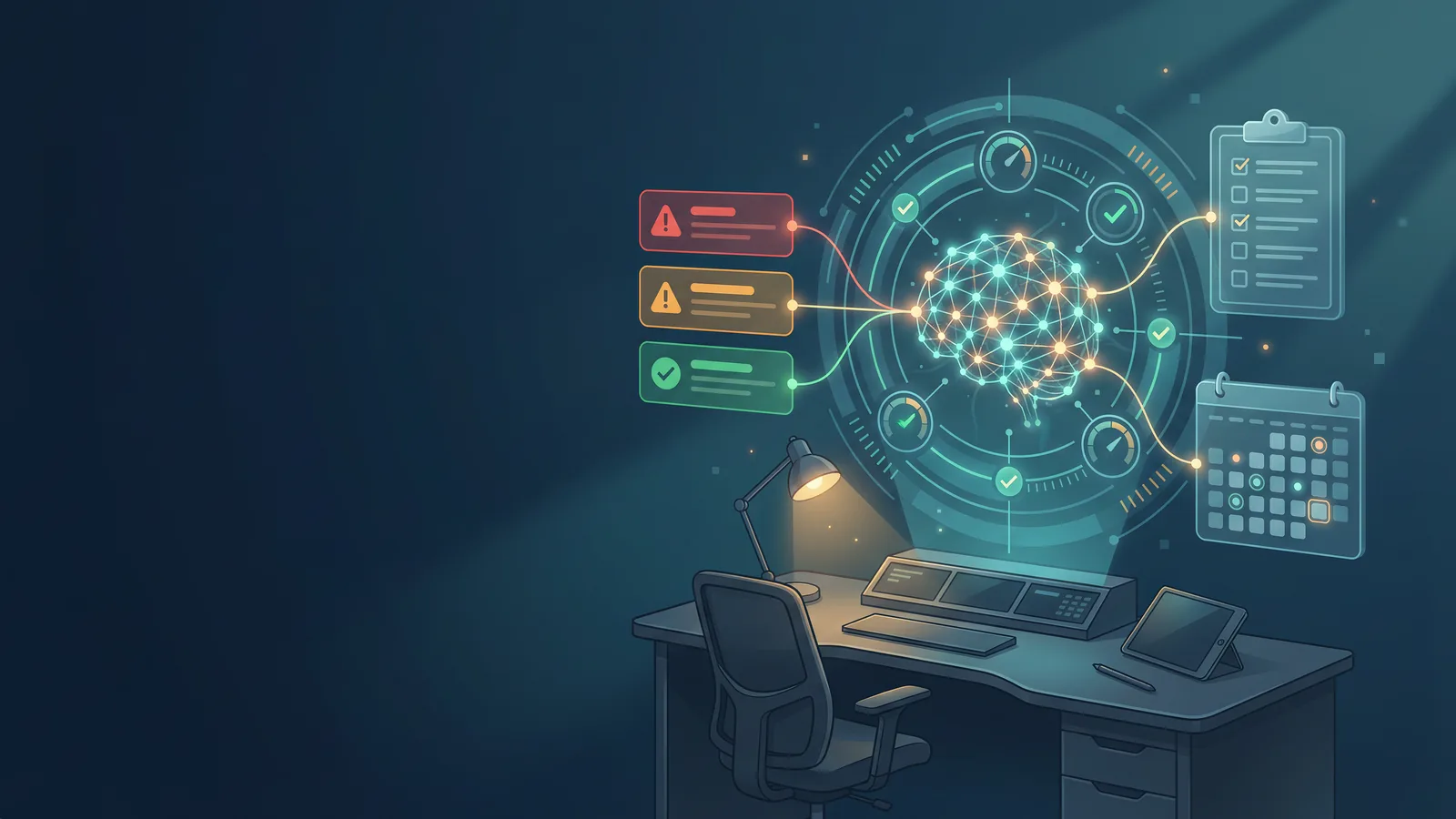
Managing AI security testing means scoping, tracking and evidencing tests of AI systems from first scope to retest. The testing itself is done by a tester. The management is the record of what was in scope, what was found, who owns each fix and whether the retest passed, kept in a form your governance team can use. Once the Security Testing module supports AI testing, GRCLens will provide that record alongside your ISO/IEC 42001 and risk work.
What does it mean to manage AI security testing?
Testing an AI system is the technical job: a tester tries to make a chatbot, a document search assistant, an agent or a voice receptionist leak data, ignore its rules or take unsafe actions. Managing the testing is the governance job around it. Someone has to agree what is in scope and who authorised it, make sure results are recorded in a consistent way, assign owners to fixes, confirm that fixes work, and show an auditor or board what was done.
GRCLens is built for that second job. It is a governance platform that gives oversight across the lines of defence, and that focus is deliberate. It keeps the record and the accountability, and it does not run the tests. To see how a test is carried out, read how AI penetration testing works on the Security Solution Consultants website.
Why are AI tests harder to track than a web application test?
Three things change the record.
- Results are not fully repeatable. The same attack can work three times in twenty, so a single pass or fail means little, and a finding needs the number of attempts and successes recorded.
- The system under test moves. A new model version, a prompt edit or a new data source can make last month's result out of date, so each finding must say which model, version and configuration it was seen on.
- Tools and data permissions set the blast radius. The same prompt injection is a nuisance in a text-only chatbot and a serious incident in an agent that can send email or move money. For the governance side of agents, see governing AI agents under ISO 42001.
What does a test record need to hold?
A useful record holds the items below. Test cases are labelled to the public frameworks your teams use: the OWASP Top 10 for LLM Applications (2026 edition), the OWASP Top 10 for Agentic Applications for 2026, and MITRE ATLAS. The edition should be named on every record.
| Field | What it holds |
|---|---|
| Scope and authorisation | What is in and out of scope, and the written authorisation to test |
| System tested | The system, with model, provider and version, and the date observed |
| Test cases | The cases that were run, labelled to the frameworks above, with the edition named |
| Evidence | Redacted transcripts and notes that support each finding |
| Severity | The rating, and the success rate recorded as successes out of attempts |
| Class | Security, privacy, safety or trustworthiness, so each can be reported separately |
| Owner | The person accountable for the fix |
| Retest status | Fixed, partly fixed, not fixed or could not retest |
Safety findings, such as harmful or biased output, are real findings, but they are reported separately so they do not blur the security picture.
GRCLens already holds engagements, findings and retests in its Security Testing module (see GRCLens modules), which has checklists and four services: security testing, threat modelling, application code review and architectural design review. The module will support an AI security testing service with its own record fields and checklists.
How should AI findings be rated?
The standard scoring system, CVSS, fits conventional flaws such as a vulnerable inference server. It fits poorly for findings that are probabilistic or driven by plain text. A practical approach is a likelihood and impact rating.
- Likelihood looks at who can do it (anyone, an authenticated user or only an insider), whether a victim has to do anything, how reliably it works (recorded as successes out of attempts) and how much effort the attacker needs.
- Impact looks at the data exposed, what the AI can do (text only, reversible actions, or irreversible ones such as paying or deleting), how many users or tenants are affected, any harm in the customer's own policy, and regulatory exposure.
GRCLens already computes an OWASP-style risk rating on the server for threat models, and AI findings will use the same approach with AI-specific factors. Findings that are conventional vulnerabilities keep their CVSS score.
How does evidence get handled?
AI test evidence is unusual. It is mostly conversation text, and by design it contains attack content and sometimes real personal or health information the system exposed. Good practice is to:
- redact transcripts before they go into any report;
- store them as plain text so attack content is never rendered as live content;
- describe any exposed real data rather than paste it;
- flag findings that contain harmful content so they stay out of shareable summaries;
- keep a retention period after which raw evidence is purged.
Tester notes should never hold customer keys or passwords.
GRCLens will support redacted transcripts, a harmful-content flag and separate handling of evidence in AI engagements, and will keep raw transcripts out of its own AI summaries. GRCLens does not use customer data to train AI models.
How do findings move from raised to retested?
A finding is raised with its rating and owner. The owner fixes it, or the organisation formally accepts the risk, and then marks it ready for retest and records which model and configuration are now deployed. If the model version has changed since the original test, the retest has to confirm that results are still comparable. The tester re-runs the original attacks at the same number of attempts, plus variants, because fixes built on keyword filters often fail when the attack is reworded. The outcome is fixed, partly fixed, not fixed or could not retest. A partly fixed finding stays open.
Retest after any change to the model, the prompts, the tools or the data sources the system uses, and on a schedule proportionate to risk. The Australian Government's Guidance for AI Adoption includes testing proportionate to risk as one of its practices. GRCLens already supports retests inside engagements. For the wider rules, see AI governance rules in Australia and New Zealand.
How do test results link to ISO/IEC 42001 and your AI risk register?
A test result is evidence about whether a control is working. The mapping to individual ISO/IEC 42001 controls should be made against your purchased copy of the standard, and this article does not reproduce the standard's text.
GRCLens has an ISO/IEC 42001 framework and risk registers (see also AI management systems), and Security Testing findings can already be raised to the risk register. Linking an AI finding to the matching ISO/IEC 42001 control record will be supported in the same way. The result is one chain: a test finding, the risk it creates, the control it affects and the management review that decides what to do.
Where does governance oversight end and testing begin?
This is where the lines of defence model earns its place.
- First line: the team that owns the AI system fixes the findings.
- Second line: risk, compliance or security governance sets the rating approach, tracks acceptance of risk and reports to leadership.
- Third line: internal audit independently checks that the process works.
The tester, whether Security Solution Consultants or your own provider, is a source of independent technical evidence for all three.
GRCLens sits in the oversight layer. That scope is deliberate and a strength: it keeps accountability clear, keeps the evidence in one place, and does not pretend that software can replace a skilled tester. It does not connect to your cloud, identity or network controls, and it does not run AI attacks.
Next step
If you want to see how engagements, findings and retests are managed today, book a GRCLens demo. If you need a tester for an AI system, Security Solution Consultants delivers AI penetration testing and AI security consulting.
Frequently asked questions
How do you manage an AI penetration testing engagement?
Agree scope and authorisation in writing, run the tests in a separate environment, record each finding with its model version, rating and owner, track fixes, and retest. Keep the evidence redacted and the whole record in one place so it can be shown to an auditor.
What does a record of an AI test need to hold?
The scope and authorisation, the system and model version, the test cases, the evidence, the severity and success rate, the owner and the retest status. Each finding is also classed as security, privacy, safety or trustworthiness, so they can be reported separately.
How often should AI systems be retested?
After any change to the model, prompts, tools or data sources, because earlier results may no longer apply. Beyond that, set a schedule that matches the risk of the system.
How do AI security test results support ISO/IEC 42001?
They are evidence that controls are, or are not, working. A failed test shows a weakness in how an AI system is managed, and a passed retest shows a fix. Linking each finding to the relevant control area and risk gives management review a factual basis.
Can GRC software run AI penetration tests?
No. GRC software manages and evidences testing; testers carry it out. GRCLens is a governance oversight platform and does not run attacks.
What is the difference between AI governance and AI security testing?
AI governance sets the policies, accountability and risk decisions for AI use. AI security testing checks by attack whether a specific system holds up. Testing produces evidence that governance relies on.
How do you rate an AI finding if CVSS does not fit?
Use a likelihood and impact rating. Likelihood covers access needed, reliability (successes out of attempts) and attacker effort. Impact covers data exposed, actions the AI can take, how many users are affected and regulatory exposure. Keep CVSS for conventional vulnerabilities.
Who owns an AI finding across the lines of defence?
The team that owns the AI system fixes it. Risk or governance staff set the rating approach and track risk acceptance, and internal audit checks the process independently. The tester supplies the technical evidence.
Sources
Keep reading

Governing AI Agents Under ISO/IEC 42001: Registers, Impact Assessments and Evidence
ISO/IEC 42001 was published before most organisations ran AI agents, but its structure fits them well. How to extend an AI management system to agents: the register, the impact assessment trigger, the life cycle controls and the evidence.

AI Model Risk Management for Banks in 2026: What APRA, MAS, BNM, HKMA and the CBUAE Now Expect
In April 2026 APRA told banks their AI governance is not keeping pace with adoption. MAS is finalising AI risk guidelines, the CBUAE has issued its own, and US supervisors have rewritten model risk guidance. What regulators across the region now expect, and where they agree.
AI Governance in Australia and NZ: 2026 Guide
Australia and New Zealand chose existing laws over an AI Act. What is mandatory, what is voluntary, and what starts in December 2026.